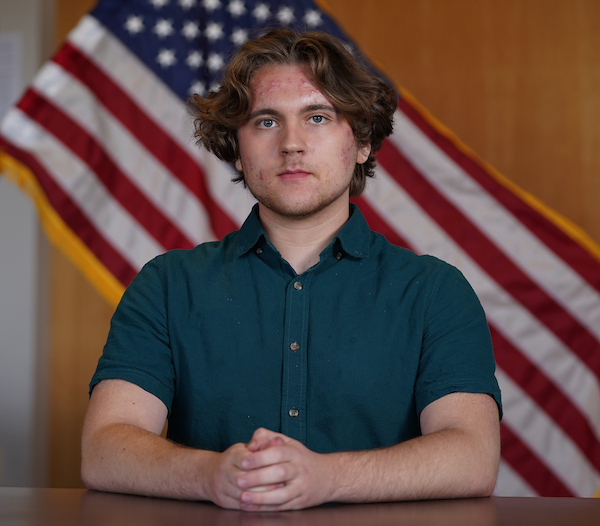
My legs shook and my voice was sore from shouting into a crappy megaphone, but after seeing the sitting president of the United States call my friends, family (and to some extent – me) “animals,” I knew that I had to speak up.
“It feels a little strange to be up here,” I began. “Because of, yeah, the nerves, but I don’t feel like I, of all people, should be giving a speech at a protest — like, I’m just a guy.”
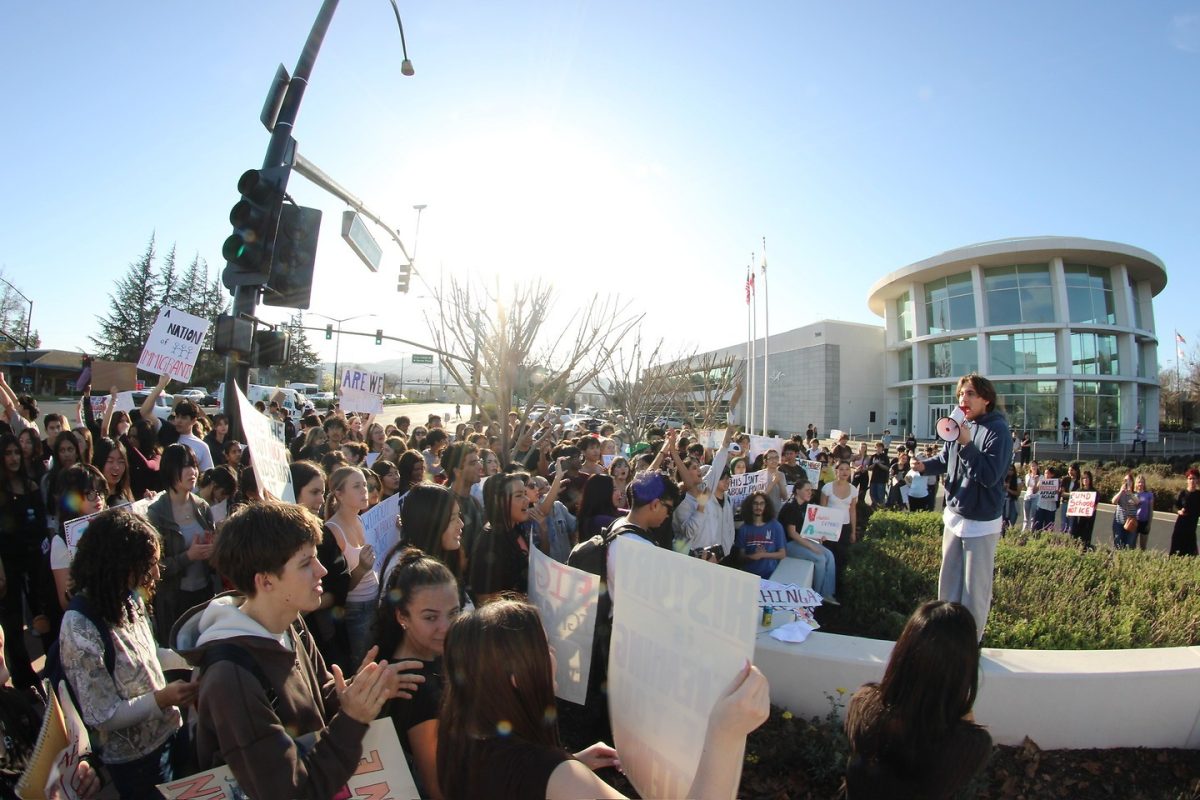
But it was my belief in this country’s ideals — ideals it’s preached yet somehow never fully attained — that made me join hundreds of students from California High School in San Ramon as the clock struck 2 p.m. on Feb. 6 to rally against recent ICE actions across the nation. Together, we walked out of our classrooms and started a 40-minute march toward City Hall.
Students learned of the protest through the account “goodtroubleyouth” on Instagram. Who says social media is a teenage scourge when it can organize over 300 students to demonstrate? The account, created by fellow 12th grader Hailey Yi, was inspired by the Indivisible Tri-Valley volunteer group and its “Good Trouble” events.
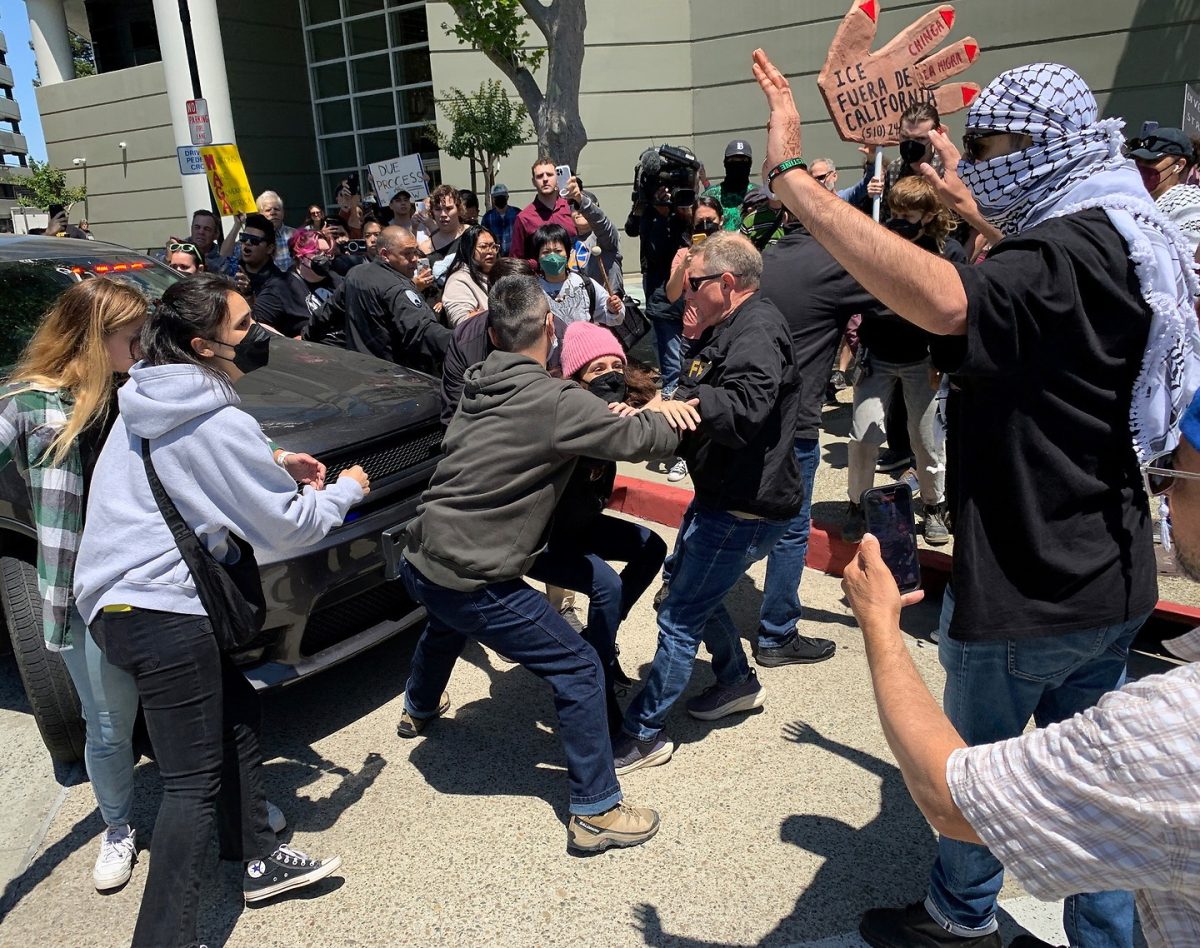
The rally wasn’t specifically advertised as a protest against ICE, though many students said the main reason for going was the deaths at the hands of border patrol or ICE agents during President Donald Trump’s second term. For me, the shootings of two Minneapolis, Minnesota, residents were fresh on my mind, as were the imperialistic actions taken by the U.S. in Venezuela and the horrific implications of the recent release of the Jeffrey Epstein files.
But what got me out the door, what got me to hand out flyers and help my friends who organized the walkout instead of being a social media warrior — what got me to stand up and give a speech in front of hundreds of my classmates — was the profound sense of complacency I felt in my own community.
San Ramon is a small, sheltered, upper-middle-class city. It’s a West Coast hub for the corporate offices of AT&T and GE Digital, and as of 2024, PG&E was its largest employer. Such privilege affords my peers a level of dissociation. Who wants to know about what their country supports, what their country perpetrates on its own citizens, when your daily life remains unchanged?
My speech in front of City Hall began simply enough:
“So I’ll be honest, hopefully that helps with the nerves. … Entirely honest — I need you guys to stay with me now — I’ll be honest with everyone by describing what I’ll do after this protest,” I said. “I’ll get home, procrastinate on all of the work I have to do for next week, and instead, will doomscroll and bomb my friends with slop-ridden reels. Then, I’ll go out and just drive around with my friends, and we’ll definitely eat, ’cus we’re all fat. And then I’ll go home, I’ll sleep. And I’ll wake up and have a normal weekend. Most of us will have a pretty normal weekend. A pretty normal rest of our week. A normal month. A normal year (except for juniors, you guys get to suffer.)
My point is, we are normal students in normal San Ramon. Our daily lives are basically unchanged, even with everything going on. Which is why it’s strange and uncomfortable to get a glimpse of just how abnormal it is outside this bubble.”
The truth is that in 2025, 32 people died in ICE custody, according to The Guardian. The truth is that ICE has been buying up giant warehouses across the country to house the men, women and children it rounds up, at best denying them due process and at worst putting them in American concentration camps. The truth is that as a birthright citizen of the United States, my family worried about me attending protests because of my native language, Spanish.
For me, the disruption of the school day was necessary. What is happening in my country isn’t normal, so purposefully disrupting our normal routine became imperative.
“Our everyday lives are still normal, but thinking that our country is the ‘same as always’ will poison the very roots that have made it stand tall for 250 years!” I shouted to the crowd.
Blinding our eyes and complying with unjust policies is the foundation of a dying democracy. It was so inspiring for me to see my classmates marching in the streets, chanting in protest, and cheering so loudly that I could barely hear my own voice yelling into the megaphone.
“We don’t go quietly into the night!” I yelled, channeling my inner Dylan Thomas. “We march, we rage against democracy’s waning moon, our voices so loud the light cannot be extinguished!”
But as thrilling as it was to give a passionate speech in front of a responsive crowd and to hear others do the same, that wasn’t what stuck with me. Instead, it was participating as one of the many students marching to City Hall. It was crossing the street in a hurry as we held up our signs to cars that honked in support. It was being part of a collective, a group of young Americans from a multitude of different backgrounds who believed they deserved better. Who made good trouble.
Viewpoints features opinion writing by student journalists. These essays reflect the writers’ individual perspectives and are published to foster thoughtful dialogue within our community.