(Editor’s Note: This is the first story of a two-part series on the increasing crisis facing BART.)
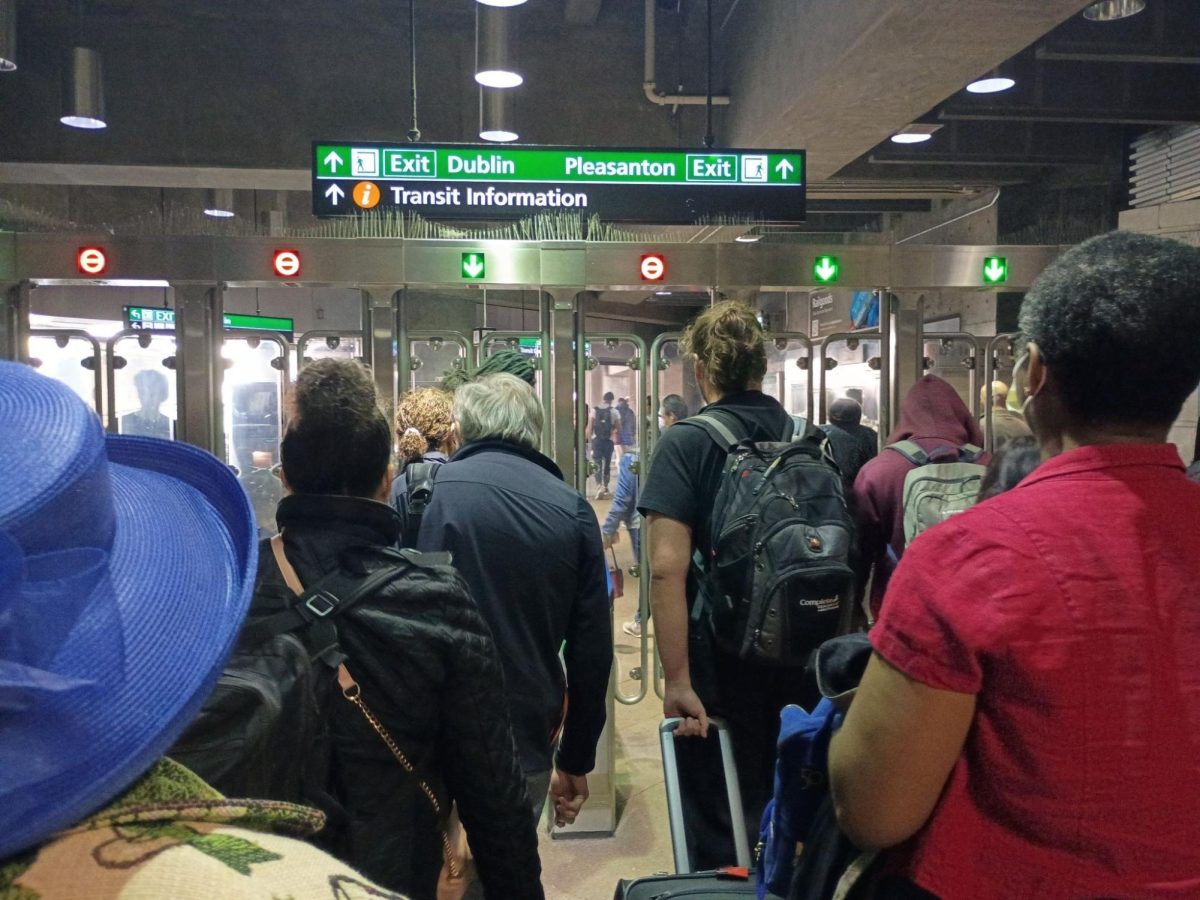
For many Bay Area residents, Bay Area Rapid Transit (BART) is a huge part of daily life –– whether it’s for commuting or leisure.
Some say that BART is essential to Bay Area mobility, but after the COVID-19 pandemic (now in the endemic phase, according to the World Health Organization) certain issues have resurfaced that challenge BART’s longevity in the community.
Due to pandemic outcomes such as the increased popularity of remote work and the reduced frequency of riders taking trips on BART, the transit system is now facing a structural deficit of up to $400 million, a number seemingly difficult to recover given BART’s funding model.
“Our funding model has historically relied on BART fares to pay the majority of our operating budget,” said Alicia Trost, chief communications officer at BART. “We’ve been filling that hole using emergency funds from the state government, but those funds literally run out this year.”
Those funds refer to a $590 million emergency loan given to Bay Area transit agencies by the state of California in February, intended to keep them operating until voters decide on a potential November ballot measure that could provide greater financial assistance.
BART has approached what is known as a fiscal cliff, where its lack of sufficient funding could lead to serious cuts to service, such as the proposed closure of nearly 15 stations, a 30% fare increase and a schedule change that will end daily service at 9 p.m.
These changes have a widespread impact that affects more than just BART riders — it also has economic and environmental consequences for the region.
“More congestion and more driving leads to worse air quality in the region,” said Sebastian Petty, senior transportation policy adviser at San Francisco Bay Area Planning and Urban Research Association (SPUR). “It also impacts real estate … a lot of our plans to grow housing in the region are tied to having a functioning transit system.”

(Chioma Onyema)
To prevent these drastic reductions to service, California Gov. Gavin Newsom signed Senate Bill 63 into law in October 2025.
The law, also known as the Connect Bay Area Act, authorizes a regional ballot measure to be placed before voters in five Bay Area counties this November.
It allows for a 14-year sales tax in the counties of Contra Costa, Alameda, San Mateo, Santa Clara and San Francisco. Each will receive a 0.5% sales tax, while the county of San Francisco will receive a 1% sales tax.
SB 63 was introduced by California State Sens. Jesse Arreguín, D-Berkeley, and Scott Wiener, D-San Francisco, in order to address the funding shortfalls of major Bay Area transit agencies –– BART, the San Francisco Municipal Transportation Agency (Muni), Caltrain and AC Transit.
In addition to many oversight provisions, SB 63 creates a new five-county governmental entity called the Public Transit Revenue Measure District that is asked with distributing funding. The entity also has the same membership as the Metropolitan Transportation Commission (MTC), which is a nine-county agency responsible for planning, financing and coordinating transportation throughout the Bay Area.
Despite SB 63 falling within its primary scope of work, the MTC chose not to place the measure directly on the ballot and instead supported a citizen-initiative process, which would require only a simple majority voter approval (51%) to pass if it qualifies for the ballot.
“We at MTC absolutely recognize that additional taxes are not popular,” said John Goodwin, assistant director of communications at MTC. “The question is, if it qualifies for the ballot, will it have majority support? That’s for the voters to decide.”
Different tax sources considered
That being said, higher sales taxes were not the first course of action considered; they were, however, the only option that officials could ultimately agree on during SB 63’s development.
“One of the other types of tax sources discussed was a gross receipts tax or a payroll tax,” said Petty of SPUR. “It’s really hard to get different counties to agree on that kind of mechanism … sales tax was one of the options that all the jurisdictions involved had more familiarity and comfort with.”
Even so, many Bay Area residents are feeling quite uncomfortable with paying more in taxes, which leads some to question BART’s increased funding demands despite reduced ridership. The agency’s Trost said she finds this skepticism to be a misunderstanding of how much BART has actually done to cut costs, and she attributes the growing financial strain to a global factor: inflation.
“We have data that shows we’re one of the most efficient rail operations in the country,” Trost said. “Why is it more expensive now to operate BART than it was before the pandemic? The entire country saw record-high inflation, and we were not immune to that.”
To cut costs without significantly reducing service through fiscal year 2026, BART has run shorter trains to save $27 million in energy, implemented a hiring freeze on 56 positions to save $7.8 million annually, and downsized its headquarters office space by 33% to save about $15 million annually.
With these efficiency measures, BART has been able to focus on promoting ridership through cleaner trains and increased security, leading weekend ridership levels to recover to 85% of what they were pre-pandemic.
Still, SB 63 does not fund upgrades to the BART system, as it only provides $310 million to the agency, which is not nearly enough of what’s needed to address its deficit. The funds from SB 63 are restricted to operations and maintaining current service levels, meaning the budget for improvement projects will not expand without another revenue source.
As a result, BART must operate under financial constraints while also working to recover pre-pandemic ridership levels. Petty acknowledges that this balancing act makes the agency’s economic challenges difficult to mitigate.
“If you cut service back, you’re kind of making the transit not as good for anyone who wants to use it,” Petty said. “If there was a way for BART to cut itself to solvency, I think they would be attempting to do it.”
In light of all of the challenges that BART faces, it’s completely up to the citizen initiative to get SB 63 on the ballot.
Barry Barnes, the general campaign consultant for Connect Bay Area, said he is confident the initiative will reach the required 186,000 signatures by its deadline in early June. As of April 6, the campaign was already halfway there.
“There’s a group of transit advocates … hundreds of volunteers who are committed to saving BART and all the transit,” Barnes said. “They’re going out every day gathering signatures at events at BART stations, grocery stores and anywhere they can find people in the five counties.”
If enough signatures are gathered by the deadline, part two of the campaign will run from July through November, where advertising and communication become key to winning voter support. Ultimately, Bay Area voters will have to decide whether higher taxes are worth avoiding major service cuts in order to secure BART’s long-term stability.