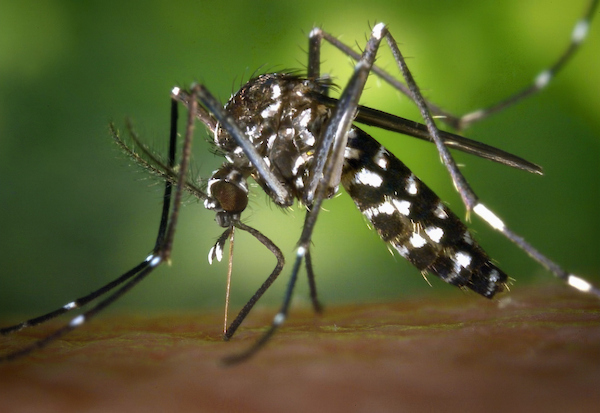
Residents of Antioch may notice fewer mosquitoes as winter sets in, but county officials warn that eggs of the invasive Aedes aegypti may survive the cold and pose the risk of yellow fever again next year.
Steve Schutz, scientific programs manager for the Contra Costa Mosquito and Vector Control District, said that as of this season, 314 Aedes aegypti mosquitoes were trapped in Antioch, including 235 females and 79 males. While the presence of these mosquitoes poses a potential risk, Schutz explained that no local transmission has been reported so far. The mosquito is known to carry diseases such as yellow fever, dengue, Zika and chikungunya.
“We fortunately have not seen any local transmission of those diseases in Contra Costa County,” he said, “although the Aedes aegypti mosquitoes are still present in the same area of Antioch where we found them last year.”
Schutz also warned that while adult mosquitoes may die off in colder months, their eggs can survive and hatch when water returns, meaning the risk could reemerge next season. He noted that eradication efforts rely on residents cooperating with inspections and mosquito control measures, and cautioned that the species could spread to other parts of the county if containers with eggs are moved.
According to the Contra Costa Mosquito and Vector Control District (CCMVCD), more Aedes aegypti mosquitoes were found between Lone Tree Way and Hillcrest Avenue. The district’s website confirms that Aedes aegypti has been found in Contra Costa County as recently as a month ago. Previously, they were first detected in Antioch in late September 2024 in response to a public complaint.
“First discovered them in Antioch towards the end of last summer,” Schutz said. “Somebody called us about being bitten by mosquitoes in their backyard, and we sent one of our technicians there to investigate, and he collected some samples, and they turned out to be Aedes aegypti.”
Unlike most mosquitoes native to California, Aedes aegypti are highly adapted to urban environments. “They’re very well adapted to living around people,” Schutz explained. “They’ll lay eggs in any little container that holds water … other mosquitoes may be coming from marshes or larger bodies of water, but these will come from any little cup or swimming pool or small container.”
A Centers for Disease Control and Prevention report shows that an egg can take as little as seven to 10 days to develop into an adult mosquito. Furthermore, their eggs can survive drying out for up to eight months, and once water returns, they develop into larvae, then pupae, and finally adults, repeating the cycle. These characteristics make them particularly efficient at exploiting small containers of standing water commonly found in someone’s backyard. Even a flowerpot tray, pet water dish, or bottle cap can become a breeding ground for mosquitoes in just a week.
To control their spread, the CCMVCD has increased inspections and larval control operations. “We have been doing inspections in the area, so basically knocking on people’s doors and asking if we could check their backyards and looking for mosquito sources,” Schutz said. “We’ve also done a couple larval mosquito control operations where we disperse tiny droplets of a bacterial larvicide that will settle into those little containers in people’s yards and hopefully, kill the larvae.”
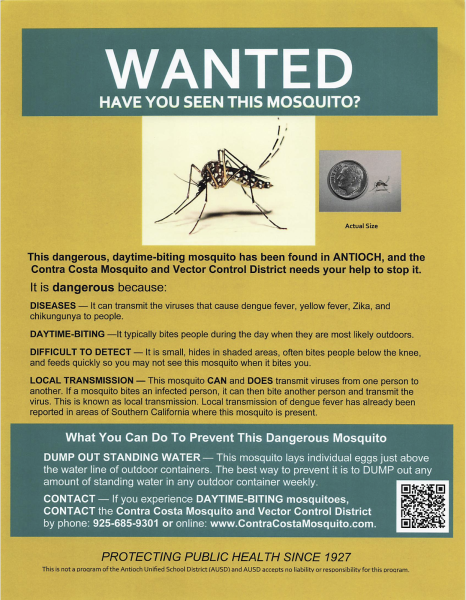
Public outreach has also been a major part of the district’s strategy. Nola Woods, public affairs director for CCMVCD, confirmed the district has actively communicated with local officials and schools through social media, and directly with the community.
“We’ve held community meetings in parks there in Antioch, so that folks can come and get their questions answered,” Woods said. “We have sent direct mail, like postcards to the homes in Antioch, where we continue to find these dangerous mosquitoes, making them aware of what they are, what the risk is, what we are doing about it, and then what the residents can do about it.”
Local residents have expressed concern about the new mosquito threat. “First of all, like the name alone kind of got me scared,” said Daniela Edeh. “I thought this was like some foreign creature, like somewhere else.” Natalia Cortez added, “The thought that came most to mind was probably worried. ”
As cooler weather arrives, mosquito activity may decrease temporarily, but eggs can survive for months until warmer temperatures return. “If you deny them water,” Woods said, “then you’re denying them the opportunity for those eggs to develop into new adult mosquitoes.”
Residents are encouraged to check their property weekly for standing water in containers such as buckets, flowerpot trays and pet water dishes, and empty them promptly. Using EPA-registered pellets, maintaining intact window and door screens, and reporting mosquito problems to the district can further reduce risk. Residents may call the district at (925) 685-9301 or email at www.ContraCostaMosquito.com.
The use of mosquitofish is also available for ponds, horse troughs, or other water features. These fish eat hundreds of mosquito larvae per day, and district staff will inspect the site and place the fish if appropriate.
By understanding the risks, eliminating standing water, and cooperating with the county’s ongoing efforts, Antioch residents can help prevent the spread of these invasive mosquitoes and protect community health.